
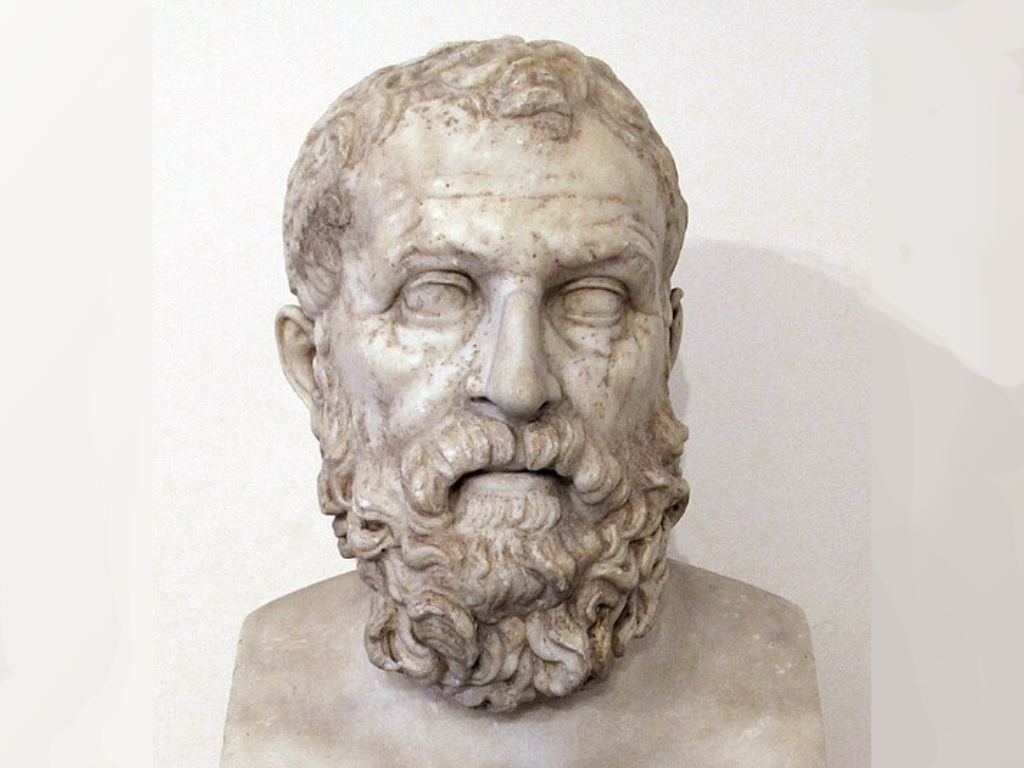
Ancient bust of Solon who governed Athens in the early 6th century BCE
Ten years ago Britain voted for Brexit. Since then we have had five prime ministers – six if you include Cameron. On average it is time Keir Starmer was replaced, and there are indeed plots to this effect.
In other countries too, new movements have arisen with an anti-establishment feel. Some have gained power, notably Trump in the USA. Why is it happening?
Historians have observed similar movements. At times of crisis, like wars and floods, most victims respond by cooperating on a local level, seeing what needs doing straight away and getting on with it. Some go looting but most help whoever is in need around them. A mutually supportive society develops. Later, as things settle down, the sense of mutual support declines. Individuals compete against each other for social status. Some get rich. Inequality arises, with class divisions. Eventually there is conflict between the powerful minority and the poor majority.
Quite often, at this stage, tyrants arise. They are usually one of two types. Some act on behalf of the powerful minority and establish a regime of oppression. They are valued for re-establishing discipline. For all his faults, people said, Mussolini made the trains run on time. The discipline being re-established may seem important to some but not to others: the colonels who overthrew the democratic government of Greece in 1967 immediately legislated to ban long hair in young men and miniskirts in young women.
These tyrants preserve the power of the elite and punish anyone who challenges them. Other tyrants redistribute wealth, typically by cancelling debts. In ancient Athens Draco represented one type, Solon the other. In Rome, Sulla and Marius. What both types have in common is that popular opinion longs for a strongman to come and sort out the mess.
Our mess is similar. The first half of the twentieth century was an oppressive and murderous era: the First World War, an international depression and the Second World War. By the end of that, the whole world was crying out for rescue. They wanted peace, but they didn’t want to go back to the Depression. They wanted something new, something that respected everybody’s needs. 1948 produced the Universal Declaration of Human Rights.
For thirty years we had an era of welfare states. The details varied from country to country, but governments legislated to ensure that everyone had enough food and somewhere decent to live. Children had schools to attend, the sick had doctors and hospitals which wouldn’t cost too much. The elderly had pensions. For most people the quality of life improved greatly.
From around fifty years ago this was then put into reverse. The reversing has happened at different rates in different countries and on different provisions. Today the richest are incomparably richer than ever before. The corollary is ‘the cost of living crisis’, now at last publicly discussed, though it has been growing for a long time.
Once again public opinion despises politicians of all traditional parties, and longs for someone with power to intervene and put everything right. Somebody who isn’t stained by traditional politics. Who might that be?
The word ‘tyrant’ now has negative connotations, but once again both types are on offer. Reform UK, like similar parties in other countries, is led by multimillionaires who want to retain the inequality and punish dissidents; but they are supported by people who feel, and often are, oppressed and powerless. The leadership offers them people to blame for their sorry state: immigrants, refugees, the unemployed, people on benefits – anybody except the multimillionaires themselves. We know what it’s like: at times of desperation we put our trust in something that probably won’t help, but just may.
The other type is represented by the Green Party. Its traditional focus is protecting the environment from destruction, but it knows that concern about the state of the world in ten years’ time isn’t going to inspire people who are struggling to feed the family and pay the rent right now.
I have no reason to suppose the word ‘tyrant’ would be a fair description of any future leader in Britain – and I leave it to Americans to judge whether it is fair of Trump. But the word seems appropriate to the mood of the moment, now that so many people are rejecting what we have had so far and long for someone to bring this era to an end.
So are you hoping for a new era?
What would it be like? What needs to change?
Do we need a new constitution – with a better voting system, or citizens’ assemblies?
Or do we need different objectives? Different hopes? Different values?
When I was on day release at the College of Commerce in 1967, I had a talented friend who was a Young Communist. With him for a few weeks I attended their meetings in Stokes Croft. I used to be amused by their idealism and naivity. Hungary in ’56. Czechoslovakia in ’68, Berlin Wall in ’89, Ukraine in 2014, were yet to be revealed. In the 1930’s Soviet communism was seen by many British intellectuals as the only political model to emulate in order to counter fascism. Both in fact were tyrannical. Somehow Britain stayed clear of both, whilst on the principle of ‘the better of two evils’ and ‘my enemy’s enemny is my friend’, became an ally of USSR in the 2nd WW. 1948 became both an idealistic water-shed with the start of the UN Charter etc. whilst at the same time the start of a new dark ‘Iron Curtain’/Nuclear chapter. Now ironically we discover that Britain, has by stealth (whilst no one was looking) become a ‘democratically elected’ tyranny, passing laws that enables the state to arrest and criminalise law-abiding citizens, whilst abroad engaging in immoral wars without proper consulation or consent. Unbelievably we have actually facilitated the mass murder of women and children, the obliteration of Gaza and the mass starvation of millions. If this is not tyranny what is? Yet the ‘1984 propaganda machine’ keeps the population docile and compliant – just a repeat of the classical ‘bread and circuses’. So in answer to your question, we need to find a way to free ourselves from what George Galloway coined as ‘the two cheeks of the same arse’, without slipping into worse ‘strong man’ tyranny or anarchic chaos. We could do worse than re-establishing the principle of free speech and assembly and repealing all the laws that mitigate it. Covid of course was the dry run for worse to come. As King Charles stated to the American Congress, “it is not what we say but what we do that counts.” Behind a despicable smoke screen of “values”, Britain has slipped into despotism and been responsible for the very opposite of them, whilst under a financially corrupt zionist ‘spell’. As a fundamental first step we need to free ourselves completely from its terrible influence. Something that has incredibly made us anti-libertarian and complicit in genocide.
Thanks Tim.