
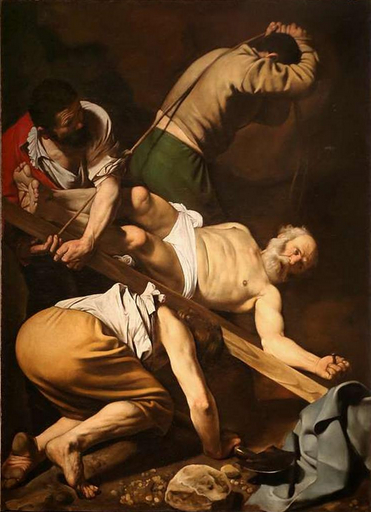
Crucifixion of Saint Peter
Caravaggio
c. 1600
This is a reflection on one of the Bible readings set for this coming Sunday. Do you wish this passage wasn’t it?
It is to your credit if, being aware of God, you endure pain while suffering unjustly. If you endure when you are beaten for doing wrong, where is the credit in that? But if you endure when you do right and suffer for it, you have God’s approval. For to this you have been called, because Christ also suffered for you, leaving you an example, so that you should follow in his steps.
‘He committed no sin,
and no deceit was found in his mouth.’
When he was abused, he did not return abuse; when he suffered, he did not threaten; but he entrusted himself to the one who judges justly (1 Peter 2:19-23).
Context
There is always a context. Who says to whom ‘if you endure when you do right and suffer for it, you have God’s approval’? If it’s the powerful saying it to the powerless, it’s just one more form of oppression. So what’s the context?
We have a problem. 500 years ago Reformation Protestants argued against the teaching of the Catholic Church, saying that the Bible is to be accepted as it is, the literal meaning alone, and all ethical advice is to be taken as universally and eternally binding. In that case, this piece of advice, like everything in the Bible, would apply equally to everyone regardless of context. Churches are so used to this that we forget to ask about the context.
Peter
So what was the context? 1 Peter is one of the epistles written around the middle of the first century, or a little later, to Christians who were being persecuted for being Christians. We don’t know the author was Peter, but it may have been.
There is evidence that Peter himself was crucified like Jesus, though he felt unworthy to die the same way as Jesus so he asked to be crucified upside down.
This morning’s readings are the ones laid down in the lectionary. The people who fixed the lectionary included the bits of the Bible they thought would be most helpful and left out the rest. Before and after this passage we get some advice the committee saw fit to leave out:
For the Lord’s sake accept the authority of every human institution, whether of the emperor as supreme, or of governors, as sent by him to punish those who do wrong and to praise those who do right (1 Peter 2:13-14).
Slaves, accept the authority of your masters with all deference, not only those who are kind and gentle but also those who are harsh (1 Peter 2:18).
Wives, in the same way, accept the authority of your husbands, so that, even if some of them do not obey the word, they may be won over without a word by their wives’ conduct (1 Peter 3:1).
The context matters! Christians were being persecuted. They had two options: either to recant and stop being a Christian, or to stick with their Christianity and get punished for it, perhaps with death. This epistle is urging them to hold fast, confident that God would approve.
It is advice to the powerless. It is the kind of advice you will get if you publicly support Palestine Action or Extinction Rebellion or Just Stop Oil. The point is: don’t give the authorities any legitimate reason to find fault with you.
Persecution
Why were Christians being persecuted? 300 years later the Roman emperor Constantine sponsored Christianity and instructed the bishops to establish a statement of what Christians believe, so that any bishop who refused to sign it would be sent into exile. Thus arose the Nicene Creed. Ever since then many people have defined Christianity in terms of what people believe.
But that was in the fourth century. In the first century people believed in a wide range of gods, demigods, demons, children of gods. In the first century no emperor punished people for what they believed about the gods. They were persecuting Christians not for what they believed but for what they did. Another Bible reading due to be read this Sunday is from the book of Acts:
Awe came upon everyone, because many wonders and signs were being done by the apostles. All who believed were together and had all things in common; they would sell their possessions and goods and distribute the proceeds to all, as any had need (Acts 2:43-45).
At the time every city in the Roman empire contained countless destitute beggars. Plenty of texts have survived telling Christians to share what they have with them. The Didache, a Christian text from the first or second century, instructs:
Give to everybody who begs from you, without looking for any repayment, for the Father wants that we should share his gracious bounty to all… Let your alms grow damp with sweat in your hand, until you know who it is you are giving them to (Didache 1.5.6).
The Shepherd of Hermas, a second century text, gives a similar instruction:
In that day on which you fast you shall taste nothing except bread and water, and you shall reckon the price of the expense for that day which you are going to keep, of the foods which you would have eaten, and you shall give it to a widow or an orphan or to some one destitute, and you shall thus be humble-minded (Similitude 5.3.7).
These texts could just be forgotten by later Christians. 1 Peter could not be forgotten because it was in the Bible; but it could be reinterpreted, as it often has been, as top-down instruction to ordinary people to obey their elders and betters.
Back in the first century the culture of the ruling classes was competitive. The rich competed against each other to become richer still and acquire greater honour. Christians rejected the competitiveness and the wealth that went with it. They believed the world’s resources had been provided by God to be shared by everyone, so everyone should have their share. They didn’t threaten the ruling classes, either physically or economically. They just developed a different lifestyle and showed that it worked. Pagans knew Christians had a reputation for giving to beggars, and laughed at them for being so stupid. But who decides what counts as stupid? Faced with persecution enough of those early Christians stood firm, doing what the book of Acts says they did.
Today the world is once again governed by obsessives competing against each other to make as much money as they can for themselves, while the price is paid by the poor and hungry. Do you think they are right? Or did the early Christians have a point?