
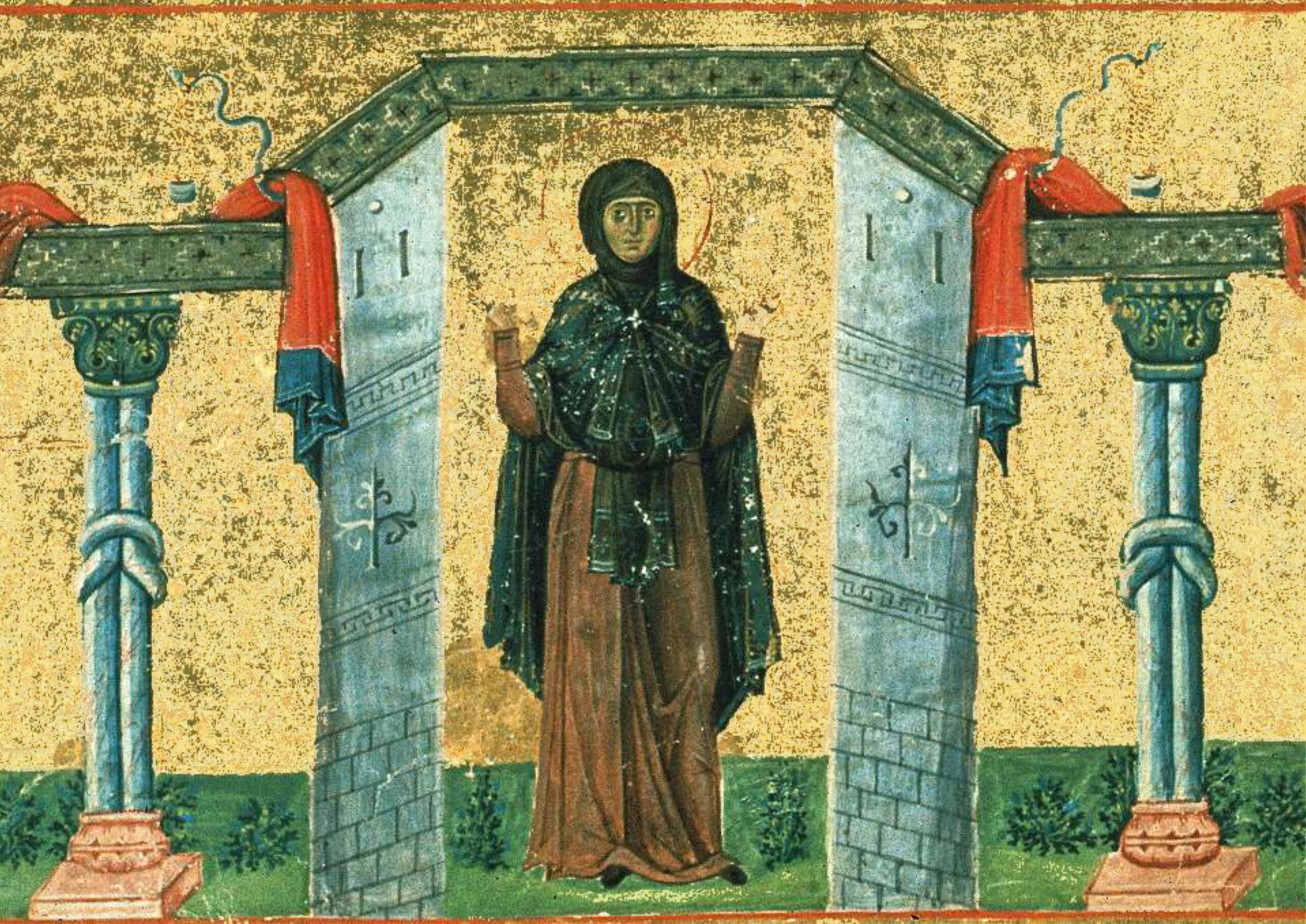
Melania the Younger, via Wikimedia Commons
Melania and Pinian, a wealthy 5th century couple, were committed to sharing their wealth with the poor. Because they were Christians. While touring Egypt they approached the monk Abba Hephestion, asking him to accept ‘a little gold’. He refused.
Melania hid the gold piece in the monk’s store of salt. Gerontius, who recorded the story, described what happened next:
After they had crossed the river, the man of God ran toward them, holding the gold and shouting ‘Why do I want this?’ Holy Melania said to him, ‘In order to give it to those in need.’ He solelmnly swore that he would not keep it nor give it away, chiefly because the place was a desert and none of the needy was able to come there. Because they could not persuade him to accept their gold, the holy man threw it into the river after a long discussion.
Why give?
I came across this story in Richard Finn’s Almsgiving in the Later Roman Empire. Finn points out the contradiction between these two Christian principles. Both wanted to live an ascetic life. For Melania and Pinion that meant giving away their wealth to the poor. The monk, equally committed to his cell ‘bereft of all property other than a mat and two storage baskets for salt and biscuits’, was determined not to accept it. Giving to the poor was what bishops were expected to do, but when monks were given money to pass on, they might be accused of being ‘money-loving’. Because of this, monks often refused gifts.
Early Christian literature is full of stories like this, praising people who were determined to share their wealth with the needy. I am repeating it now because of the contrast with the values we today have been brought up to accept as normal. By our standards, to live like them seems crazy.
How does it compare?
Yet we also know what a disaster our version of normality is. For 50 years the rich have been getting richer and the poor have been getting poorer. The British people who voted Labour last year were hoping for a change of direction, with billionaires taxed enough to provide for those now dependent on food banks.
Our disappointment on that score pales into insignificance compared with the American version. Donald Trump, the most powerful person in the world, does business with the rich and powerful and doesn’t care what happens to anyone else.
None of it is necessary. We really could do things differently. Other societies often have done. We turn up our noses at them for not having our technology and lifestyles, but they didn’t do so much damage.
In times of war governments forget the theories. They decide what needs doing and compel people to do it. Following this pattern, immediately after the Second World War there was an international movement to improve the quality of life. The immediate post-war mentality meant it lasted around 30 years. Since then the rich and powerful have once again taken over.
So it’s worth remembering a movement that lasted longer than 30 years. 400 years after Jesus said ‘Give to everyone who asks’,[1] Melania, Pinian and Abba Hephestion were still following his lead.
Anybody can feel pity for a stranger in distress. In the cities of the Roman empire beggars would sit wherever they stood a chance of receiving a gift. Children were sometimes maimed or blinded for the purpose of begging more successfully. We may be horrified, but it tells us two things: first, how desperate beggars were for something to eat; and second, that some people were moved to give.
Sympathy and justice
That was an appeal to the heartstrings. The early Christian movement taught people to give as a matter of justice. Food and water were given by God to meet everybody’s needs, so for anyone to lack the essentials was injustice. Many of the destitute were rescued by a monastery, where they would receive the basics: food, water, shelter. Those who had something to spare were to give to whoever was in need. In this way the movement grew.
These early Christian stories were accompanied by the inevitable questions. How much can donors keep for themselves? Which recipients should take priority? Should donors give to a bishop or monk for redistribution, so that the donation is anonymous? Or should they give directly so that they have to see and smell the people they are giving to?
Of course it is impossible to prove those stories true. No statements about the past can be proved. Scholars who oppose Christianity may prefer not to believe it made much difference. Even Christian scholars may be unaware of this central element of their tradition, so neglected by church leaders today. It is likely that many of the stories were exaggerated, but they still expressed the expectations people had.
As we wonder what will happen next to our own very different society, it is worth recalling that story of Melania and Hephestion. Our present system, straitjacketed by its economic theories, has lasted 50 years. It is showing signs that it can’t last much longer. Melania and Hephestion were doing what Christians had been doing for 400 years. For another thousand years and more, other Christians continued to do it. Only in the eighteenth century was the virtue of giving to the poor suppressed in the name of capitalist economic theory.
Yes, there are alternatives. We don’t need to carry on as we are. We could make sure everyone has enough and nobody has too much. We could even do it in the name of justice.
Notes
1. Matthew 5:42.
Universal basic wage and realistic income/property/land tax on the rich?
Always asuming we can avert climate catastrophe: https://tinyurl.com/ybafy54z
Indeed. It’s doable. In 50 years’ time our descendants will be furious with us for letting the situation get like this.
Some stats – makes depressing reading. https://equalitytrust.org.uk/scale-economic-inequality-uk/
And a discussion on the results of wealth inequality. https://buddingsociologist.in/wealth-inequality-and-its-societal-consequences/
Wealth inequality is bad for everyone – more equal societies are healthier and happier. This is the message we need to promote.
Thanks. Everything is going the wrong way!