
 We’re celebrating! Modern Church has an impressive record of promoting liberal theology, and it’s now 100 years since our most celebrated conference. What we did in 1921 made front page news in the national newspapers. We’re marking it with a day conference on 11th September, and you can book here.
The 1921 title was ‘Christ and the Creeds’. Of course a lot of what got said then is water under the bridge; but the main points are still convincing, and – sadly – still need to be made. This post focuses on the Christ bit. I plan another on the creeds.
The divinity of Christ
The biggest controversy was over whether, and how, Christ was divine. I confess that I have rarely been bothered about this question. However the Conference speakers drew out an issue which still affects religious attitudes.
The following quotations are from 1921. I hope you will agree that, apart from the lack of gender inclusive language, they still read well today. Given how quickly religious language gets out of date, this itself is impressive.
The main accusation was that the conference speakers didn’t believe in the divinity of Christ. In fact none of the speakers denied it; but they explained it in a way that horrified many church leaders at the time. I suspect they would horrify church leaders today every bit as much, but in my view they were right.
Their overall case was to stress what humanity and divinity have in common. As Henry Major, the General Secretary, put it:
The Deity of Jesus is to be seen in His perfect Humanity.
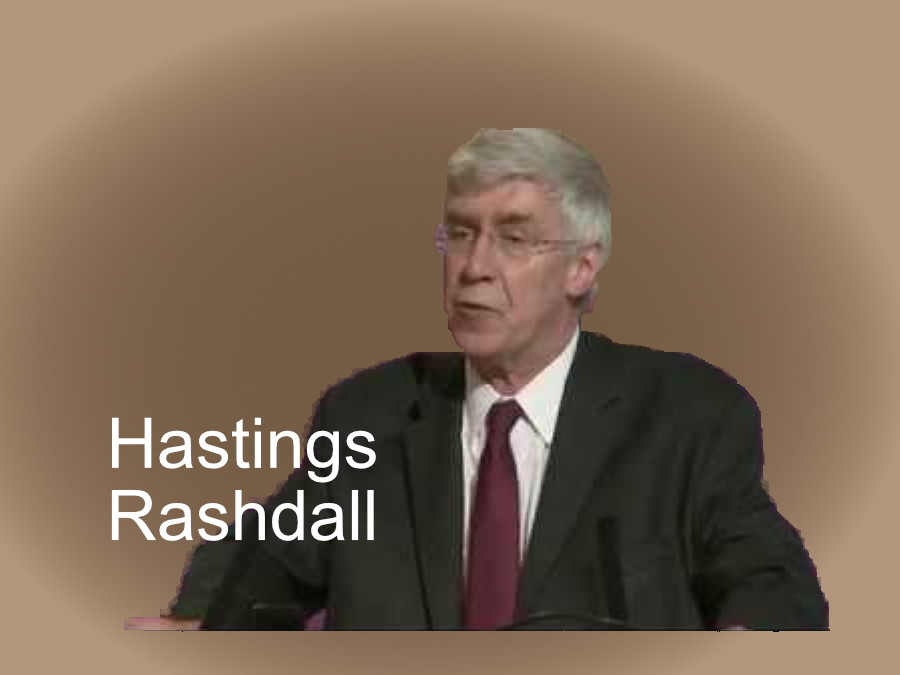
Hastings Rashdall, the Modernists’ leading theologian, spelled it out most clearly:
If we believe that every human soul reveals, reproduces, incarnates God to some extent; if we believe that in the great ethical teachers of mankind, the great religious personalities, the founders, the reformers of religions, the heroes, the prophets, the saints, God is more fully revealed than in other men: if we believe that up to the coming of Christ there had been a gradual, continuous, and on the whole progressive revelation of God…, then it becomes possible to believe that in one Man the self-revelation of God has been signal, supreme, unique.
Michael Glazebrook, the Conference Chair, described the attempts of the first Christians to explain what was special about Jesus. They drew on familiar stories. Jews had their stories of Enoch and Elijah going straight to heaven at the end of their virtuous lives. Romans had similar stories – he cites Pollux and Hercules. Peter’s speeches in Acts 2 and 10, he said, are of this type. A different tradition was of gods taking the form of humans while still acting and speaking as gods. This, he said, has echoes in Philippians and John.
Since 1921 many scholars have debated the connections, but what is of interest here is that Glazebrook’s point echoes Rashdall’s:
Whereas Jewish and Greek traditions alike represented God and man as belonging to two different orders of being, so contrasted and opposed that they could have no natural relation, Jesus affirmed that they were bound together by a real kinship. Thus He described the repentance of the sinner, not as a change of nature, but as a return to normal relations, an acknowledgment of the essential unity between the Father in heaven and His sons on earth.
Major analysed the point like this:
Jesus regarded all men as sons of God. This Divine Sonship may be called natural sonship, because it belongs to all men as men. It may also be called moral and spiritual sonship, because man possesses a nature which is essentially moral and spiritual… It may also be called potential sonship, because this Divine Sonship is in man’s case a dynamic rather than a static thing, and it is capable of immense development.
Why was this anathema to so many Christians? Every religious tradition contains tensions within it. One of these tensions is about how the tradition describes the condition of being human. Some accounts are static, others are dynamic.
In the case of Christianity, the difference has often been expressed in theories about the divinity of Christ. Because I have always been puzzled about how steamed up some people can get about the divinity of Christ, I’m inclined to suspect that these doctrines are the front end of something deep-seated, something perhaps more psychological.
The Conference speakers stressed that Jesus was a real human. They thought he was more godly than other humans, but the same kind of being. It is as though there is a spectrum of humanity, from the ungodly to the godly. What distinguishes Jesus is that he was at one end of it, more godly than you and me.
Empirically, of course, we don’t have enough evidence to know whether Jesus lived a life more morally perfect than anyone else; but that wasn’t debated. What got people steamed up was the stress on Jesus being fully human just like other people.
To think of the divinity of Christ along those lines is to produce an agenda for human living. The agenda is progressive and ethical. It means life doesn’t have to be like this. It could be better. To make it better we can become more divine, more like Jesus.
This theology suited people who wanted the world to become a better place. Rashdall and his colleagues could show that their position was in keeping with a great deal of New Testament and early Christian teaching – and so can their successors today.
But their opponents can also appeal to the tradition, including the New Testament.The Christian churches have often been run by people who don’t want a progressive agenda – people who want things to stay the way they are. Churches have often been on the side of preserving the status quo.
I think of the difference between the two as a bit like Remembrance Day speeches. They often say that others gave their lives fighting so that we could be free. Bad Remembrance Day speeches may give the impression that those sacrifices gave us freedom once and for all. For those who think like this, the implication is that the present state is ideal and secure. In that case, we don’t need to defend it: what they did was quite unlike anything we will ever have to do.
In the same way, some theologies of Christ’s divinity argue that he achieved a salvation effective for all time, leaving us with nothing extra to do. In theologies like this the humanity of Christ becomes irrelevant; he achieved what he achieved because he was divine. It all happened a long time ago, leaving us to accept the present state of affairs as permanent. The implication is that we don’t have to do anything except carry on as we are.
So: was Jesus a divine technician who came to earth to install a new spiritual battery for the world, and then left us to get on with life as before? Or was he a human so full of God that he showed us how we too can be full of God? In my view the 1921 Modernists were right, and their case still needs to be made today.
Greek philosophers had no problem with suggesting that superlatively virtuous persons were “godly”, and even that Dion (aka John Doe) was God’s equal if he was truly virtuous. They would of course require some evidence of such superlative virtue (and as you remark, we have no secure biographical information that Jesus was particularly virtuous – the inference rather runs the other way, that because he is God the Son he is virtue incarnate). Philosophical sects could elevate their founders to something like that status, even if they didn’t all believe in gods who would intervene in mortal life: Epicurus, for example, is held up as a great exemplar and illuminator almost equivalent to Gautama Buddha. Porphyry at least represented his teacher Plotinus as one who received divine illumination, and was linked directly to “a god” even before he was taken up into the dance of immortal love. The early Church took a far more radical and far more interesting line, like but also unlike Philo’s view of Moses (and the Samaritans’): that Jesus was identically God, and not merely (vaguely) inspired or godly (probably Arians were closer still to their notions). He was (and therefore also is) the uncreated Word on whom the whole creation rests (whereas in Islam and mainstream Judaism it is the written text that embodies that uncreated Word). So, no, I don’t think those Modernists were right – they were feebly endorsing a not very interesting heresy, and abandoning the distinctive features of their own tradition.
Thanks for this – especially your information about the ancient Greek philosophers. The relevant quote from Glazebrook is:
When Horace wrote: ‘’Twas by such efforts the Pollux and the wandering Hercules attained to the heavenly citadel’:
Hac arte Pollux et vagus Hercules
Enisus arces attigit igneas.
he expressed what was for his own circle a literary convention, but for the mass of the people a strong if subconscious conviction.
End of quote.
But I disagree with your summary of early Church doctrine. The current consensus is that there was a wide range of views. This makes it all the more likely that the different accounts of Christ in the New Testament reflect a real diversity. I’m not sure how you would square your account with the Adoptionist Christology in Mark, for example. In practice, for all the many attempts to impose uniformity of belief, opinions have always varied. One of the great strengths of that Modernist movement was the willing acceptance of diversity of belief.
Certainly opinions varied, and went on varying, as Christians struggled to find some way of articulating their experience and history. All sorts of options were explored, and some may have survived quite a long time before they were, by general consensus, judged inadequate. My point was that the “modernist” account – crudely, that Jesus was a godly person with some familiar advice – would have been quite unproblematic (and boring). The doctrine that took shape over years, decades, centuries was far more radical, and far more interesting. It can also be played against another pagan option (with Zeus as Allfather and Heracles as his divinized son): that was a serious contender for a Roman imperial cult (see Liebeschutz: Continuity and Change in Roman Religion, 1979) – and also very different from the orthodox Christian option.
For me, what makes it interesting is the ‘so what?’ bit. If Jesus was as human as you or I, and also the most ‘godly’ human being ever, what does that mean for how you and I approach God and our fellow humans? If Jesus can be ‘fully godly’, then you and I can be, too. How do we go about that? By turning away from our old life to follow his Way – Richard Rohr suggests beginning with the Sermon on the Mount. Imagine if everyone lived their lives by those instructions! Would that not be the Kingdom of God?