
 Eucharist, Communion, Mass, Lord’s Supper. For the first Christians, it was their central activity. It was what they gathered for. Why?
The usual story goes like this. On the day before he died, Jesus gathered with the twelve apostles for the kind of meal groups of Jewish men often shared at the Passover Festival, with bread and wine. Jesus said of the bread ‘This is my body’ and of the wine ‘This is my blood’. He also said ‘Do this in remembrance of me’. 150 years after the death of Jesus, and from then on, the standard explanation of the Communion Service has been that Christians are doing what Jesus told them to do at the Last Supper.
Being the son of a vicarage I was brought up with it. In the 1970s I was taught it in greater detail at theological college. Being made to write essays about it made me think: this is boring.
Have millions of people been doing this for almost 2,000 years just because Jesus once said ‘Do this in remembrance of me’? Jesus also said ‘Sell all your possessions and give the money to the poor’. Why aren’t we all doing that as well? Okay, he only said that to one person, but he only said ‘Do this in remembrance of me’ to 12 people, and they are now all dead. Yet the Eucharist was the central act from the beginning of Christianity. There must have been more to it.
Then I discovered some New Testament scholars with a different account of what Jesus was about. What follows is my own understanding, drawing on a variety of scholars I find convincing.
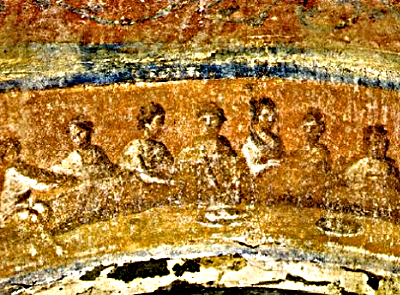
Catacomb of Priscilla, Rome, 3rd Century
From all the evidence we’ve got, it took 150 years before anybody thought they were doing it because of Jesus’ instruction at the Last Supper. During that time no texts make the connection, not even the New Testament accounts of the Last Supper. The Christian art of that period, mainly in the catacombs, show people celebrating the Eucharist. There are never 13 of them, which would have been right for the Last Supper, and they never have wine. They are eating bread and fish. Sometimes, five loaves and two fishes. There was an earlier reason for the Eucharist, which has largely been forgotten. What was it?
I’ll give you two clues. The first is that term ‘Last Supper’. There must have been previous suppers. The second is the word they used. They didn’t say ‘Communion Service’. They said they were doing a Eucharist, which is a Greek word meaning ‘thank you’. They were thanking God for their suppers. Why is that such a big deal?
Jesus started his movement in Galilee. The Jewish tradition believed the world has been created by one good god, who has provided enough food for everybody to eat. When some people go hungry, that’s because other people are taking more than their share. So the Old Testament contains a lot of laws to protect the poor. Interest on loans were forbidden, debts were to be cancelled every seven years.
It wasn’t happening in Jesus’ day. Galilee was part of the Roman Empire. The Romans didn’t mind how many Galileans starved to death, provided there were enough left to grow the food and pay the taxes.
In the Roman Empire somewhere between five and ten percent of the population were destitute. They had no regular income at all. They would survive as beggars, burglars or bandits until they failed and starved to death. In Galilee, the percentage of destitute people was even higher, more like 15%. Galilee was fertile land, good for growing food. The reason for the starvation was basically taxes.
Jesus preached about the Kingdom of God. What he meant by that was how we would live if we did things God’s way. If we did things God’s way everybody would have enough to eat. People are starving because of the Roman taxes. On the other hand, despite the Roman taxes, between us we still have some food. Why don’t we pool our resources, come together bringing what we’ve got, and share it out equally? It was a kind of food insurance policy. One day you get a job as a day labourer, you are paid a bit of money, you spend it on food, and share it with the others. The next day somebody else gets a paid job and they share it, so you still eat.
On a practical level it made sense to those people. What gave it wider appeal was the conviction that went with it. God has designed the world so that when we care for each other, we all get what we need. God makes the crops grow, so instead of lamenting how little we’ve got we thank God for what we do have. We express our thanks by sharing what we have with people in need. This was how to live God’s kingdom despite the Romans.
To me, this is a far better explanation of the Eucharist. It explains why it was the central act for the early Christians. They didn’t begin it after the Last Supper; they just carried on doing what Jesus had started up. It was absolutely important because it meant real food for the starving.
It was also important because it gave those starving people dignity. They were not receiving hand-outs from benevolent charities. They were eating what God had given for them to eat. For them to eat was God’s justice, God’s kingdom.
In the Roman Empire, Galilee was a backwater. The ruling classes didn’t care what went on in Galilee. Yet 300 years after Jesus, Christianity became the official cult of the Empire. Historians still argue about how that happened. The pious say it was the Holy Spirit, busier than usual, converting people. Sceptics say it was just a succession of accidents. To me, the most convincing explanation is the Eucharist. All over the Roman Empire there were people starving. The new Christian movement offered food with dignity. Along with the food came a philosophy of life: for everyone to have enough to eat is the way God intends, the way life should be, the Kingdom of God.
As the idea spread, these meals got adapted to fit local customs. Paul, in one of his moods, wrote to the church at Corinth:
When you come together, it is not really to eat the Lord’s supper. For when the time comes to eat, each of you goes ahead with your own supper, and one goes hungry and another becomes drunk. What! Do you not have homes to eat and drink in? Or do you show contempt for the church of God and humiliate those who have nothing? (1 Cor 11:20-22)
25 years after the death of Jesus, Christians at Corinth had inherited the thanksgiving meal in the name of God’s kingdom, but adapted it to the normal practice of Greek dinner parties. Paul complains that they miss the whole point, because they are eating separately, eating different amounts of food, and taking positions of rank and status.
Yet, the Corinthians had to adapt it somehow. After all, some of them had homes where they could eat.
So do Christians today. We too have to adapt it somehow. Yet we also want to retain Jesus’ vision of the Kingdom of God. So how should we adapt it? When we kneel at the altar rail for a symbolic piece of bread and sip of wine, are we doing the same thing? Is the food bank a better expression of what Jesus began?
Greetings and peace in Christ! I’m way late to respond to this post – just happened across it while googling something else, and thought I could help.
When you say it was the central act of worship for early Christians, but you didn’t know why, have you consulted extrabiblical sources, such as the Church Fathers? It didn’t take them 150 years – Ignatius of Antioch (who studied under the Apostle John) writing around 100-110 AD, Justin Martyr ca. 150 AD, Irenaeus ca. 190 AD, etc. (the list is actually quite long) are pretty explicit about the why: It’s Christ’s true body and blood, the sacrificial lamb, and by eating it we are joined to the sacrificial altar of the Crucifixion, and transformed by it. They aren’t inventing or arguing for the position either, they’re explaining what the Christian position already was (and was “since it was handed down by the Apostles,” they say). Paul concurs in 1 Cor. 18-21. Christian historian J.N.D Kelly has shown it was a normative understanding to the 2nd generation (immediately following the Apostles).
The whole “sacrificial lamb” part may not make any sense without understanding the Jewish context: the Mosaic covenant, the forms of worship and sacrifice required since Exodus (including the weekly “Bread of the Presence [of God]”), sin and guilt sacrifices, todah sacrifices (which go all the way back to Melchizedek), God’s requirement to eat the sacrifices to be part of them, and critically how Jesus in his sacrifice and Eucharist fulfills all of these. This is a great way to connect Old Testament to New Testament – it’s about fulfilling a lot more than just the coming Messiah: God is much more rational and consistent than that. Augustine ca. 350-430 AD wrote a lot about the Old Testament is fulfilled in the New Testament, so you need to read the Old Testament through the lens of the New, and the New through the lens of the Old, to get the full picture.
To really understand, I’d recommend “Jesus and the Jewish Roots of the Eucharist” by Dr. Brant Pitre, who pulls in the Talmud and other ancient sources to help modern readers know what an average ancient Jew would’ve known. Once you’ve got all that context, a lot of odd sayings in the New Testament make a lot more sense – otherwise it’s like trying to understand English without knowing our idioms.
The idea that anyone did it just because it was an “ordinance” of Christ (because he said so once a long time ago) and not because it actually does anything, is not quite 500 years old – you’d be looking to John Calvin, except he still had a pretty high Eucharistic theology (spiritual presence of Jesus, if not physical), so really Zwingli started the “it’s just a memorial symbol” theology, which is only in Reformed/Calvinist branches of Christianity (and their offshoots such as modern Evangelical/non-denom). Lutherans, (High Church) Anglicans, and their offshoots, plus Catholics and Orthodox (including Copts who broke communion with the mainline Catholic Church around 450 AD) all hold to the longstanding understanding of what Communion is and why we do it.
For more information about the early church view, this page can get you started: https://www.catholic.com/tract/the-real-presence
You can find complete early church writings at https://www.newadvent.org/fathers/
God be with you!
Thank you. I appreciate your response.
I’ve had another look, and I can see why ‘it took 150 years before anybody associated the Eucharist with the death of Jesus’ can easily be interpreted in a misleading way, so thank you for drawing it to my attention. I have edited it accordingly.
I actually drew on Kelly, Pitre and others in preparing this piece. Kelly was writing half a century ago and is a good example of a theologian who presupposed that later theologies must have been there from the beginning .
As for Justin, Ignatius and theologians of their age (and on other matters, Paul) they often use a range of images. Later theologians then pick out the bits they like, treat the images as definitions and ignore the images that don’t suit them. I lament the way liturgical scholars have often ignored the biblical and historical contexts of liturgical changes, as though God is very fussy about how services are conducted and doesn’t care much about what they are responding to.
My main concern was to challenge the way Eucharists today misinform people with anamneses that give the impression that they are being celebrated because Jesus so instructed at the Last Supper. That is simply not the way it happened. A better criterion for a Eucharist that truly follows Jesus’ initiative would be that the worshippers are committed to doing the thing for which he began it in the first place –
namely making sure everybody gets something to eat (echoing Genesis 1, the 8th century prophets & Deuteronomy). Hence my point about the food bank.
So thank you for this, and for improving my writing.
Thank you for your patient response – and that, even after I cited things you’ve obviously would have read, but I hadn’t poked around your site before replying to this particular post. Mea culpa; I must blame it on the early morning and me without my coffee.
If I can impinge on your patience just once more:
It’s a side point, but I think God does care about how He is worshipped; He certainly seemed to in Lev. 10:1, which I read a bit into Mt. 7:21, and the intentionally-coupled-by-Paul Lev. 20 and 1 Cor. 11:27. But I’m sure you’ve heard all of that before. In fact, apologies upfront, but if I cite something or belabor a date, it’s more for the benefit of any bystander than by my assumption you aren’t aware.
The premise of Eucharist being central because it actually fed people is novel to me and I don’t see it held up in Scripture or tradition – the early Church Fathers never intimate that as far as I have seen – could you share an example? The Didache from around 50 AD lays out a prayerful liturgy similar to the Mass, Divine Liturgy, or Holy Qurbono of today, and with Justin Martyr’s clear blueprint in 150 AD, it doesn’t sound like an earthly nourishing meal, e.g. “You gave food and drink to men for enjoyment, that they might give thanks to You; but to us You freely gave spiritual food and drink and life eternal through Your Servant” (Didache, ch. 10).
Jesus himself seems to reject the notion directly: isn’t that how the Bread of Life discourse in John 6 starts? “(Paraphrased) Why are you following me, because I fed you miraculously yesterday? Do not labor for the food which perishes, but for the food which endures to eternal life, which the Son of man will give to you.” I see that as fairly explicitly rejecting that idea.
As you cited 1 Cor. 11:20-22, what do you make of how it ends: “Do you not have homes to eat and drink in? Or do you … humiliate those who have nothing?” Connecting that with verse 34, “if any one is hungry, let him eat at home—lest you come together to be condemned,” it doesn’t sound like Christianity was spread because they gathered to share a big meal, but the opposite: Don’t humiliate those around you who have less than you; eat at home before coming to the Lord’s Supper.
I guess what I’m saying is, I see clear counterarguments to the proposition that Christianity was spread, and the Eucharist was central to it, because it provided real substantial food to a starving population. If I’m right, then the question remains: why do we do it, why is it central?
Outside of the Reformed/modern Evangelical tradition, I haven’t heard it, like baptism, being taught as something we only do because Jesus told us to. But maybe it is different outside of the US! I think the big question is whether or not you have a high view of the Eucharist. From your mention of a symbolic piece of bread, I’m inferring you’re not in that camp, so I’ll try to explain it from my standpoint of being in the Real Presence camp, for which I am counting either physical presence (different debate I know, but this seems to undeniably be the early Christian view) or Calvin’s mystical Real Presence in spirit alone.
If you have a Real Presence theology, the reason to participate in Communion is straightforward, and not only because it is an ordinance or similar: it’s because the Eucharist is the medicine of immortality, the tool Jesus gave us to become one with him, richer in God’s grace, and therefore better enabled to be charitable. That includes volunteering in soup kitchens.
I cite the Catechism of the Catholic Church here, but Luther and Calvin also thought reception of the Eucharist imparted God’s grace, and strengthened our communion with Christ, allowing us to be better people to those around us.
As the CCC puts it (p.1394), “As bodily nourishment restores lost strength, so the Eucharist strengthens our charity, which tends to be weakened in daily life… By giving himself to us Christ revives our love and enables us to break our disordered attachments to creatures and root ourselves in him.”
And, “The Eucharist commits us to the poor. To receive in truth the Body and Blood of Christ given up for us, we must recognize Christ in the poorest, his brethren” (Ibid., p.1397).
Going back to the early Church, Irenaeus said “When, therefore, the mixed cup [wine and water] and the baked bread receives the Word of God and becomes the Eucharist, the body of Christ, and from these the substance of our flesh is increased and supported, how can they say that the flesh is not capable of receiving the gift of God, which is eternal life—flesh which is nourished by the body and blood of the Lord, and is in fact a member of him?”
And elsewhere, “But our opinion is in accordance with the Eucharist, and the Eucharist in turn establishes our opinion. For we offer to Him His own, announcing consistently the fellowship and union of the flesh and Spirit. For as the bread, which is produced from the earth, when it receives the invocation of God, is no longer common bread, but the Eucharist, consisting of two realities, earthly and heavenly; so also our bodies, when they receive the Eucharist, are no longer corruptible, having the hope of the resurrection to eternity.”
Tertullian was a bit more forthright: “the flesh feeds on the body and blood of Christ [in the Eucharist], that the soul likewise may be filled with God”
That is essentially the idea: nourishing our flesh with the body of Christ makes us members of Christ, becoming both earthly and heavenly – capable of receiving God. And that’s why I participate in Communion at least weekly (as described in the Didache and by Justin Martyr), and why several converts I know have converted: to be able to access Christ in the Eucharist – that’s all the reason we need 🙂 . I’ve tried my best not to pluck any quotes out of context, but if you can direct me to differing imagery from Irenaeus or Justin or the like, I would be very interested to educate myself!
Thanks again for your patience, and for your generosity with your time. God Bless!
Once again, thank you. It is a pleasure to hear from someone both so well-informed and so courteous.
I know my position is almost unknown in churches (I am a retired vicar) and this is something I am trying to address. My first degree was in Latin, just over 50 years ago, and there was a mood in the department that I would now describe as politically right-wing. We read literature from an age when around 3% were literate. They wrote for each other and weren’t interested in the common people.
More recently there has been a huge amount of research on what life was like in 1st century Judaea and Galilee. A lot of it draws on anthropological studies of peasant societies in other parts of the world (eg James Scott). In the 1960s Gerhard Lenski’s Power and Privilege analysed how hunter-gatherer societies were more equal than agricultural empires, where kings commandeered the surplus of food to employ armies and tax collectors. The rulers of Egypt, Assyria, Babylon and Rome could demand as much tax as they liked, subject only to enough peasants surviving to sow and harvest the following year’s crop. A more nuanced recent update is David Graeber & David Wengrow’s The Dawn of Everything.
Old Testament scholars show how in reaction Israel began as a group of tribes on the less fertile hilltops, probably many of them debt refugees. From the first century CE, Josephus refers (disparagingly) to lots of protests and prophetic and messianic movements from the era. They only make sense in a society where starvation drives them to try pretty well any kind of opposition to the ruling classes, even though they knew the Romans would just send in the cavalry and kill them.
Jesus scholars now relate the gospels to widespread starvation in 1st century Galilee. Of the ones I find most helpful I would start with Richard Horsley, who writes more books than I eat dinners. Also Bruce Longenecker, Douglas Oakman, Sean Freyne and the better known John Dominic Crossan. Jesus’ healing stories show evidence of much malnutrition. The central petitions in the Lord’s Prayer (Luke’s version is probably the earliest) asks for the two things peasants need most: cancellation of debt and bread for today.
I don’t want to knock the idea that the Eucharist is specially holy. All over the world (except in modern atheism) every society has known that we live in a world maintained by forces that transcend our understanding, and we need ways to relate to this transcendence. Where I disagree with much of the liturgical tradition is that I don’t think Jesus turned some ordinary bread into something holy. He treated all bread as holy – God’s gift of food. The proper response is to give thanks. So this central act of making sure everybody gets something to eat came to be called their Thanksgiving – or in Greek, Eucharist. The Greek in the Didache, Justin, etc, faces translators with a problem. Do they translate the same phrase as ‘When you give thanks…’ or as ‘When you celebrate the Eucharist…’ It’s the same Greek word, meaning the same thing. Only later do people want to distinguish between the two. I’ve just been reading Paul Bradshaw’s Eucharistic Origins. He points out that, contrary to Dom Gregory Dix’s popular The Shape of the Eucharist, early Christian literature does not distinguish between ‘Eucharist’ and ‘agape’, or between the meal and the holy bit of it.
You write:
Outside of the Reformed/modern Evangelical tradition, I haven’t heard it, like baptism, being taught as something we only do because Jesus told us to.
In Catholic and Anglican churches, anamneses recalling the Last Supper are obligatory at Eucharists. I think this is a big mistake. It misdescribes the reason for them.
I accept that reinterpretations of the Eucharist began early. We can see the tensions in 1 Corinthians 11, where Paul berates the Corinthians for treating the Eucharist like a typical pagan dinner party, where different food is provided according to the social status of the invitees, and servants do as they are told. And wine appears, as was typical of pagan dinners. Even there, starvation was not the issue it was in Galilee. (So Paul could ask them to contribute to his collection.) By the time we get to Ignatius and Irenaeus, the original point is already in process of being forgotten. It had long since been forgotten by the time of the Reformation debates.
Your references to Leviticus don’t seem to me to be relevant to what Jesus was doing. Hebrew scholars say the Holiness Code was a product of Judah’s self-government in the Persian era, marking out how Jews were henceforth to obey different laws from everyone else. I see Jesus as willing to break those laws.
I completely agree with your last main paragraph – about the body of Christ making us members of Christ. I interpret it to mean not that consecrated bread is different from unconsecrated bread, but that all food is God’s gift, to which the appropriate response is to offer thanks – and follow this up by making sure everybody gets enough to eat. The church I usually attend runs it own food bank – which I think of as essential to eucharistising the way Jesus intended.
Sorry to have gone on so long.
Thank you for the thoughtful reply!
I think we read different things into the anamnesis, based on our traditions – in the Catholic tradition, anamnesis makes a past event become present now by action of the Holy Spirit (CCC 1103-4). The recollection is done so that, as Paul says, we can be members of the one sacrifice, one altar, one bread.
I’ll have to pick up some new books, thanks for the recommendations! In general I am skeptical of modern historical critical method scholarship, which seems to do some eisegesis from a starting bias of there is no such thing as a true miracle. For example, dating books of the Bible arguing “this book can’t have been written that early, or Jesus would’ve had foreknowledge, which obviously he can’t.” That’s not scientific, which would be open to where the evidence leads – that is starting with an assumption, and adjusting the evidence to fit.
My reference to Leviticus was that God does care how he is worshipped, as I took you to imply God wasn’t fussy – I think he is. Regarding Holiness Code, I believe most scholars do not say Leviticus is only holiness code – it also has prescriptions for worship, inauguration of the priesthood, etc. The rules around sacrifices are not to set Jews apart, but to give proper worship to God (which is why he brought them out of Egypt in the first place, that they may worship him [Ex. 4:23]) and it’s important that Paul essentially ties the Lord’s Supper into the sin offering of the Old Testament and its requirements. But that probably highlights our fundamental disconnect – we might be far apart on our core assumptions: I believe 1) the Old Testament prefigures the New Testament so these things will connect – everything in the Old Testament has import to what Jesus did; 2) everything in the totality of Scripture interconnects; 3) sin is a real thing which needs forgiveness; 4) that God performs real miracles; 5) and that God is rational and not capricious or arbitrary. To help establish a baseline, how far apart are we on that list?
The Lord’s Prayer is actually “give us this day our epiousios bread”; “epiousios” is a made up word by the evangelists – they cobbled together a new word because an existing word wasn’t sufficient. Daily (which itself would be redundant after “give us this day” anyway) would’ve simply been “hemera,” as seen elsewhere in the Bible. Consequently, Jerome had trouble translating this, and went both ways in Mt. 6:11 and Lk. 11:3. I think Jerome got it right in Matthew: give us this day our “supersubstantial” bread. This makes sense and would’ve resonated with the Jews of the time as a reference to manna (already a made up word for “what is it”), i.e., bread from heaven – a supernatural bread.
Further, I’d argue “debts” is metaphorical language on Matthew’s part – Luke’s version just says “sins” plainly – so “trespasses” gets the idea across better, and harmonizes with Luke’s version and the general Biblical sense (e.g., Mk. 11:25). If we read it as “forgive us our trespasses as we forgive others,” this makes sense with the immediately following verse, where Jesus says “For if you forgive men their trespasses, your heavenly Father also will forgive you; but if you do not forgive men their trespasses, neither will your Father forgive your trespasses.” (Mt. 6:14-15) If it’s about financial debt, what financial debt do we owe the Father? It sounds more like it’s not about debt relief but about the covenant and God’s expectations for the forgiveness of sins (which would fit in with the sin offerings, repentance, yada yada of the rest of Scripture). This fits really well with Mk. 11:25: “And whenever you stand praying, forgive, if you have anything against anyone; so that your Father also who is in heaven may forgive you your trespasses.” It’s a coherent whole.
About treating all bread as holy instead of setting up a special bread, I am curious of your perspective on how that harmonizes with John 6: ‘Jesus answered them, “Truly, truly, I say to you, you seek me, not because you saw signs, but because you ate your fill of the loaves. Do not labor for the food which perishes, but for the food which endures to eternal life, which the Son of man will give to you; for on him has God the Father set his seal.”’ (Jn. 6:26-27) He then goes on for dozens of verses elaborating on this special bread, the true manna, etc., and saying it is his flesh and blood – he says this many times, even changing verbs from “eat” to the very physical verb “chew” or “gnaw” his flesh, adding “amen amen” for emphasis, and all that he persists in the face of his disciples leaving at this “hard saying” (Jn. 6:66). That doesn’t sound like making people happy by feeding them; it sounds like turning away people who just want food, and accepting only those who want more than food – even if it seems gross and nonsensical to their fleshly sensibilities (Jn. 6:63).
Although the Greek can be confusing (see also: deacon meaning all things including the ordained office), the Didache’s specificity with Communion prayer over the gifts, and the prayer afterward, along with the direction “Give not that which is holy to the dogs” (citing Mt. 7:6) suggests a very high (holy) view of what they’re doing.
Messianic movements can make sense for reasons other than rampant poverty: We’re agreed the people are looking for the Messiah everywhere: Is John the Baptist the Messiah? John sends his disciples to ask Jesus, are you finally the Messiah? There were 2 failed Messiahs from around the time of Jesus (cf. Acts 5), and as you mention, false Messiahs are also in Josephus. The timing makes sense: not because of hunger coming to a head (there were other times the Jews were under similar duress and didn’t see a Messiah ’round every corner), but because prophesies were coming to a head. With the Deuterocanon, God wasn’t silent for 400 years before Christ – the Jews at the time would’ve known about Wisdom’s prophesy (we know they were familiar with the Greek texts, even if just orally), as well as the timing coming up for Daniel’s forecasted 490-year wait.
The supposition that it’s all based on poverty or hunger, misses the possibility that there were true believers. This is like a similar argument I’ve heard: “the Crusades were about making money, not rescuing the Holy Land” even though we know it was a huge net negative for Western Europe, many nobles bankrupted themselves financing it, and Louis and Richard, when they had accomplished their task, simply packed up and left – they didn’t financially benefit at all. For all their faults (and that’s a historical discussion for a different day), they were true believers. Such people can exist, and on a massive scale. Many modern Muslims offer perhaps a more immediate proof.
From my Real Presence perspective, to summarize: God sets up sin and guilt flesh offerings (chief among these the Passover and its remembrance), todah (thanksgiving) sacrifices, weekly unleavened Bread of the Presence [of God] offerings, etc. Adding to the Jesus prefigurement, sin offerings “if offered as a thanksgiving offering, offer unleavened bread with it” (Lev. 7:12-13), “he has put him to grief; when he makes himself an offering for sin” (Is. 53:10). Then comes Jesus, who offers himself as the culmination of all of that: the timing is right w/Daniel, he is a sin offering and a todah (scholars considered the Passover a form of todah), the sacrifice is unleavened bread and wine as required, and he is a new paschal lamb plus “blood of the new covenant,” which must be spilled if it’s to be like the Mosaic covenant (this finally fulfills Jeremiah’s new covenantal prophesy). John 6 works tidily here; without a Real Presence understanding, John 6 is internally incoherent, and all of those things God did before either didn’t really happen, or are irrational because they’re unimportant to the story, so why did God bother.
I think there’s room (and as I quoted the CCC saying earlier, the requirement) to do both: be united to Christ by the Eucharist, and that involves being more Christlike to the poor. For example, my city’s food pantry program (which to give an idea of its size/scope, distributed 3,315,000 pounds of food last year to 32,000 clients), homeless shelter program, soup kitchen, and domestic violence shelter, were all launched in the 1980’s out of the same bible study at my parish – which coincidently was also true in the last city I called home. They’re still largely staffed by church volunteers.
You’ve been exceedingly kind and gracious in spending some of your invaluable time on me, and I thank you! This has been an enjoyable conversation for me; I hope so for you as well. I apologize for the length; I am trying to substantively engage with the interesting issues you raise.
God Bless!
Thanks again.
It’s now clearer in my mind that your position is similar to what I was brought up with and have moved away from. I’m a monotheist now, and an ethicist. From my perspective I find not just the Catholic Catechism but most Protestant alternatives inconsistent. One example is relevant: Chalcedon states that Jesus was both fully human and fully divine. So did he had foreknowledge? If so he wasn’t fully human; if not he was.
On miracles, it sounds to me that you believe in the modern secular account, which I argued against on https://www.clatworthy.org/2023/08/the-changing-meaning-of-miracles/. My view would be more Thomist: a miraculum is what the Latin means, something to wonder at. The idea of laws of nature, and thus breaking them, had not yet arisen.
More generally I’m impatient of the modern western approach to religion which likes to keep it a long time ago and a long way away, so as not to interfere with us doing what we want to do with our individualist and acquisitive lives. To me, the whole biblical tradition and the Jesus movement are much more hands-on, and I lament the way it has been watered down.
I think this will have to be enough from me. Thanks for the dialogue.
Thanks for your thoughts and for sharing the dialogue with your interlocutor.
I think you are on to something, definitely interesting thoughts. “Give us this day our daily bread” and the feeding of the 5000 come to mind