 How dare it snow, and mess up our plans? What went wrong?
Okay, you and I know that nobody is to blame. No human, anyway. So why do we call it bad weather?

How dare it snow, and mess up our plans? What went wrong?
Okay, you and I know that nobody is to blame. No human, anyway. So why do we call it bad weather?
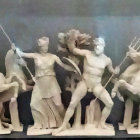 On Saturday we visited the Acropolis Museum in Athens. It is beautifully laid out, and naturally its artistic merit is unmistakeable. But there is more to it. It was not built to be art for art’s sake. Just as Plato and Aristotle have become philosophical icons not just for Greeks but for the whole western world, so also the Parthenon is iconic for western culture and architecture.
The theologian in me asks what it means. What does this icon affirm? There in the museum I felt a juxtaposition of two stories expressing radically different values.
Geneva Bible, first printed 1560
This is an edited version of a talk I gave at St Brides Liverpool on 26th March.
Among Christians the authority of the Bible, and how to read it, are hotly contested. The best known debates at the moment are about the ethics of same-sex partnerships and gender relationships.
 When I told the taxi driver that I was a priest, there was a pause. Then he said ‘Oh. I believe in evolution.’ ‘So do I’, I replied. That was too much for him. ‘I can’t take that.’
The study of evolution, like many academic disciplines, produces real insights and there is no good reason for Christians to reject it. However the case for it is undermined when its enthusiasts claim more for it than they should. I have already discussed the issues with selfish genes and evolution as a moral guide . Here I respond to the determinist argument: that everything we are, or do, must have an evolutionary cause – that we have to be the way we are for evolutionary reasons.
 What does the Bible teach? Well, pretty well anything, depending on who is speaking. Do we just accept what we were taught when we were young, or recite a few favourite texts and ignore the rest, or feel well and truly turned off by all the claims?
Here’s my potted history of biblical meaning. It is derived from a number of biblical scholars, the main one being John Barton.
 When it comes to religious beliefs, how do we know which ones are true?
The Modern Church website states that
Religious beliefs can and should develop in the light of new insights.
We have recently been asked
So what tests can be made on these ‘new insights’?
This post is my way of answering the question.
True story, from a non-religious friend. The family received a Christmas party invitation from the new neighbours who have just moved in. The invitation was to drink mulled wine and sing Christmas carols.
Sing Christmas carols? Not part of the family tradition. They had a closer look at the invitation card. It contained a biblical verse. They decided to decline the invitation.
You are stranded alone on a desert island. The perfect stereotype: sand, a few rocks, palm tree in the middle. Absolutely nothing to eat or drink. No sign of human presence.
You go to sleep, and in the morning you wake up hungry. You open your eyes and see, on a rock next to you, a plate with a fried egg, bacon, sausage and baked beans. Next to it is a glass of fruit juice and a mug of coffee. There is absolutely no sign of how it got there; no footprints, no sound of a helicopter, nothing. Hungry as you are, you scoff the whole lot.
In the ancient Sumerian city of Uruk archaeologists have found a tablet dating from the 3rd century BCE, listing the food to be given to the gods at the temple there. These gods were wooden statues. Unlike Egyptian statues which were made of stone, Mesopotamian temple gods were wooden. They needed to be; they liked holidays so they sometimes needed to be transported from place to place. Continue reading
I’ve just finished reading Jerry Brotton’s fascinating A History of the World in Twelve Maps, Allen Lane: 2012. I’ll just tell you about three.
The first is the Hereford mappamundi. It is the largest of its kind to have survived intact for nearly 800 years, and shows what the world looked like to a thirteenth century Christian. Made from an animal skin it measures 1.59 metres high and 1.34 metres wide. The world is circular and divided by the Mediterranean into Europe, Asia and Africa. East is at the top.
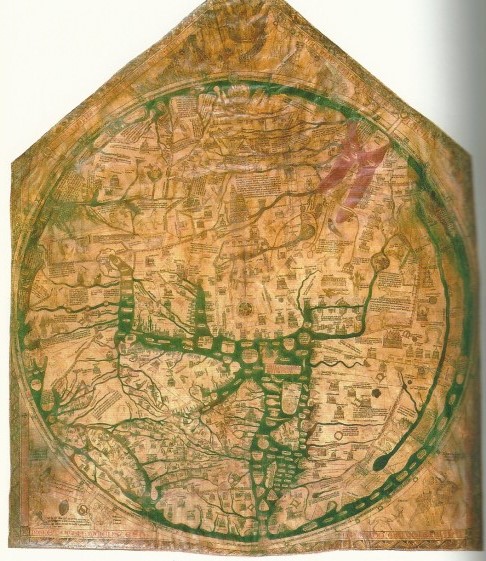 Jerusalem is right in the centre. Far away at the edges of the world are ‘all kinds of horrors, more than can be imagined,… savage people who eat human flesh and drink blood.’ At the top of the world just inside the circular border lies the Garden of Eden, inhabited by Adam and Eve. To the south they are shown being expelled from the Garden. At the very top, above the circular border, Christ presides over the Day of Judgement. At his right an angel resurrects the saved souls from their graves and at his left another angel leads the damned away to hell. Brotton comments:
The Hereford mappamundi was therefore designed to work at various levels: to display to the faithful the wonders of God’s created world; to explain the nature of creation, salvation and, ultimately, God’s final judgement; to project the history of the world through locations, moving gradually from east to west, from the beginning of time to its end; and to describe the physical and spiritual world of pilgrimage, and the ultimate end of the world. All of this is built from the long historical, philosophical and spiritual tradition it inherits, stretching back through the early Christian Fathers to Roman times.
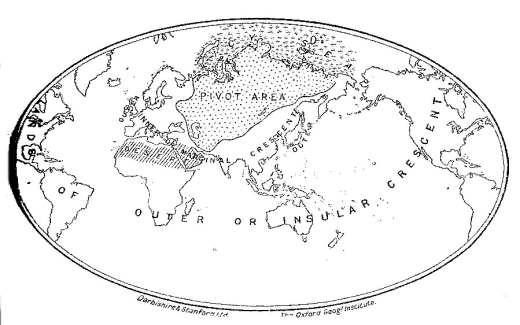
My second choice is Halford Mackinder’s world map ‘The Natural Seats of Power’, 1904. Mackinder was a British imperialist and his map is a contribution to geopolitics. According to his theory central and northern Eurasia is ‘the pivot region of the world’s politics’. World empire would be in sight if Russia and Germany formed an alliance. Surrounding the Pivot Area is the ‘inner or marginal crescent’, Europe, northern Africa, the Middle East, India and part of China. The ‘outer or insular crescent’ included Japan, Australia, the Americas, Southern Africa and Britain. He summarised his argument:
Who rules East Europe commands the Heartland:
Who rules the Heartland commands the World-Island:
Who rules the World-Island commands the World.
His theory was a major influence on both sides in the Second World War and the Cold War. In 1994 Henry Kissinger, former National Security Advisor and Secretary of State to Richard Nixon and Gerald Ford, wrote that ‘Russia regardless of who governs it, sits astride what Halford Mackinder called the geopolitical heartland, and is the heir to one of the most potent imperial traditions’. In 1997 Zbigniew Brzezinski, another former National Security Advisor, argued that ‘Eurasia is the world’s axial supercontinent’… a ‘glance at the map also suggests that a country dominant in Eurasia would almost automatically control the Middle East and Africa’. Brotton comments:
Ostensibly, Mackinder’s political geography was based on a stated desire to keep the peace. In reality, it was predicated on perpetual military conflict and international warfare, as the various pieces on his global chessboard vied with each other for increasingly scant resources.
At first sight no map could be less like the mappamundi. Brotton thinks otherwise:
To Mackinder, the Hereford mappamundi was defined not by theology, but by the geopolitics of the Crusades and the westward shift of empire from Babylon to Jerusalem. Mappaemundi were therefore simply an early confirmation of his central thesis: the enduring conflict between empires for control of a heartland. With the benefit of historical distance, we can see that Mackinder’s 1904 map is in fact a manifestation of the same kind of ideological geometry that inspired the Hereford mappamundi: the providential mission of empire had replaced the pursuit of organized religion, but both of them sought to reduce the plurality and complexity of the world to a series of timeless truths.
My third choice is the photograph of the earth taken from 33,500 kilometres away by the astronauts on the Apollo 17 spacecraft in 1972. Brotton writes:
The Apollo 17 photograph, in its depiction of both the sublime grandeur and exquisite beauty of a singular blue world floating in the dark abyss of empty, inhospitable space, inspired wonder and also indignation at the state of ‘our’ world. The language of religious awe that accompanied the photograph’s reception was quickly superseded by political and environmental reflections on the fragility of a world that united all its inhabitants, regardless of creed, colour or political orientation.
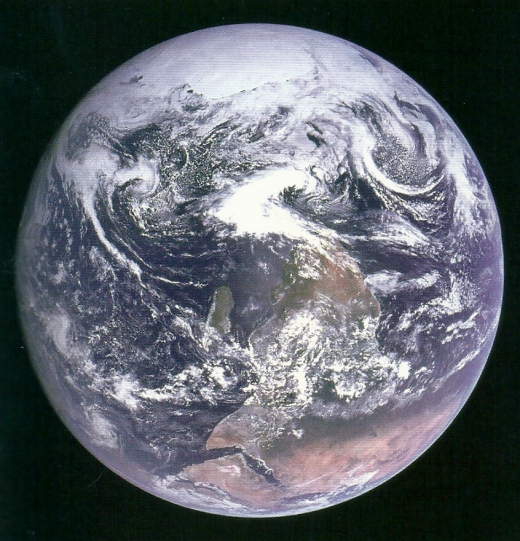 The image influenced activists, both environmental – like James Lovelock’s ‘Gaia’ theory – and economic, like the 1980 Brandt Report on the world’s economic development:
From space, we see a small and fragile ball dominated not by human activity and edifice but by a pattern of clouds, oceans, greenery and soils. Humanity’s inability to fit its doings into that pattern is changing planetary systems fundamentally.
Although Brotton does not say so, I think it has often been interpreted in a contrary way. The message of the image can also be that we are but insignificant spots in a vast uncaring universe, whizzing around and getting nowhere. We don’t matter.
Those are just three of Brotton’s maps. There are lots of others, but these are enough to offer a wide choice. You are on the way to eternal judgement; or trapped in a never-ending power struggle between imperialists; or part of a highly complex network of life-creating processes, supremely valuable but increasingly threatened; or a meaningless speck in a vast uncaring expanse of emptiness.
Compared with these, what sort of map describes where you are?