
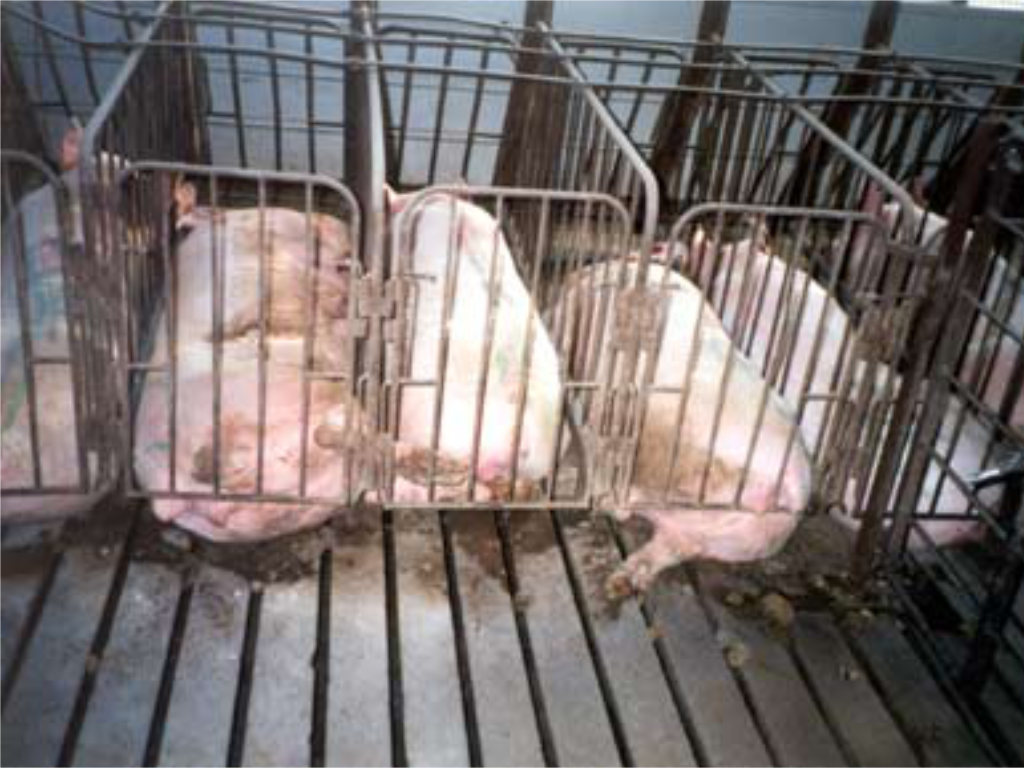
Pigs in gestation crates. https://en.wikipedia.org/wiki/Intensive_pig_farming
If you are concerned about cruelty to animals, Simon Kittle’s recent book is well worth reading: God and Non-Human Animals, in the Cambridge Elements series ‘The Problems of God’ (2025).
Simon and I attend the same church, so I am happy to give it a plug while also offering my own thoughts and inviting responses.
The book
It has four chapters. The first describes how traditional Christian theology has been very anthropocentric. Leading theologians are quoted saying the welfare of animals should be of no concern to Christians, or even – in Calvin’s case – that they have no feelings. Kittle points out how our language separates words for meat from the living animal killed to produce it, thus helping us forget the connection.
Chapter 2 offers an ethical challenge. If we can eat pigs and cows, why not eat cats and dogs? If we wouldn’t cook and eat our own pet dog because we are aware of its personality and our relationship to it, cows and pigs also have personalities and relationships. Why not treat them the same way? This is the most challenging chapter.
Chapter 3 asks what kind of god would allow animal suffering. He summarises the two most common Christian positions. One is that God has given humans freedom to do harm if we so choose; evil and suffering have human causes. The other is that an originally perfect world suffered a fall, often associated with the story of Adam, Eve and the serpent in Eden. Here the main difficulty is that there is no historical evidence of any such fall.
Chapter 4 addresses recent changes in our understanding of animals. Studies have shown that humans are not the only animals with mental abilities. We can no longer believe our mental faculties depend on a soul which only humans have.
But then, can animals sin and need redemption? Kittle makes a helpful distinction which is often obscured in Christian teaching. A creature needs redemption (or rescue) when it suffers and cannot escape the suffering; it needs reconciliation when it has done something wrong which alienates it from others. Thus infanticide has been observed among chimpanzees: should we deem them sinners?
The challenge to God
My own approach comes from a position called ‘ethical monotheism’. A good god has created a good universe and provided us with all we need to live well, but has given humans power to mess up for ourselves and others. One problem with it is that animal predation and parasitism existed for millions of years before humans evolved, so we cannot be blamed for it.
My defence goes beyond Kittle’s book. When people are horrified by the way modern agribusiness regularly mistreats animals reared for food, and campaign against it, they can tell themselves that this is their own personal ‘yuk’ response and that other people respond differently.
If this is all they believe it is consistent with atheism. In atheist theory there are no gods, so all moral values are human inventions. As such they are not truths about reality: they simply express the feelings of whichever humans have them.
Ancient polytheisms could do the same in a different way. An ancient Greek who enjoyed hunting animals might be a worshipper of Artemis; but for those who didn’t enjoy it, other gods were available. People could choose their values from the range offered by their theology.
But treating the issue as personal preference is precisely what Chapter 2 challenges. This is the kind of reason why monotheism eventually replaced polytheism: it claims that there is a truth about our moral judgements, rooted in the way the creator of the universe has designed us to live at our best. The wrongness of making animals suffer is therefore a real, objective truth, not just a personal feeling.
Suffering and morality
Putting Chapter 2 before Chapter 3 felt to me a bit like building a house, and then when it’s finished, deciding whether a house was what we wanted. Chapter 2 persuades us that eating cows and pigs really is morally wrong, and then Chapter 3 turns to what kind of god can possibly exist. I guess this expresses the preferences of a secular publisher commissioning a series on ‘the problems of God’. But our sense of moral wrongness depends on believing that there are moral truths that transcend our personal ‘yuk’ factors and whose values we have good reason to trust.
Nevertheless, as Kittle explains, one difficulty with monotheism is the amount of suffering caused by animal predation and parasitism for millions of years before humans even evolved.
My way of handling it is to reflect on what pain and suffering are like. We need to avoid two extreme positions. Kittle tells us John Calvin believed non-human animals experienced no feelings at all. The view was popularised by René Descartes, for whom other animals cannot suffer because they do not have souls. His view remained popular until the 1960s.
At the other extreme we may imagine that other species suffer in much the same way that we do. An observation by Charles Darwin has been more influential than it deserves:
I cannot persuade myself that a beneficent and omnipotent God would have designedly created the Ichneumonidae with the express intention of their feeding within the living bodies of Caterpillars, or that a cat should play with mice.
We should distinguish between pain and suffering. Pain is a physical process functioning to make its owner avoid harmful situations. In each species it has evolved to be adequate for the purpose in the relevant environment. Suffering is a mental process. We can suffer without pain, as when we regret the past or fear the future. We can willingly endure pain without suffering, as athletes and explorers do.
Comparing ourselves with other species
No human can really feel what somebody else feels when they suffer or are in pain. We just have to learn, from childhood, that other people’s feelings are much like ours. In the case of other species the difference is obviously greater and varies from one species to another. Darwin was allowing his sense of sympathy to run away with him. That caterpillars can suffer in any meaningful way is almost certainly false. Whether mice can is perhaps arguable, but in a very limited way; their brains are not big enough for feelings like ours.
Thus the suffering of animals before the evolution of humans does not seem to me a decisive argument against a good god. Human children, like other animals, play at being chased, caught and eaten. It is a possible outcome we have evolved to cope with.
What troubles me much more is what happens on a massive scale today. While chickens have evolved to cope with being chased and eaten by a fox, no chicken has evolved to cope with being cooped up inside a tiny cage all its life. The same can be said of the way pigs and cows are treated. Here we have real suffering on a massive scale.
So: do you eat meat? Do you think it matters how the animal was farmed? Would you eat your own pet cat or dog? Do you see your views as just a personal preference, or are there moral truths about how we all should be living? You can put your response in the comments.
Jonathan, you and I have discussed this a fair bit. I think we agree that the suffering we humans inflict on a monstrous scale on non-human animals is clearly and indefensibly wrong. We agree a bit less on the amount of suffering amongst animals in the millions of years or pre-human evolution. There is of course no doubt that animals feel pain, almost certainly to the same degree that we experience it. They also have emotions akin to ours – fear, anxiety, happiness. I cannot therefore discount or minimise the suffering of animals uncaused by humans. How one is to reconcile this with a loving creator is a considerable challenge, one few theologians have been brave enough (or simply aware enough) to tackle. So well done Simon Kittle and thank you Jonathan for joining an extremely important debate.